Amazon FBA Fee Changes 2026: What Changed and How to Prepare

Sellerise Team, Contributor

3 min read -

Updated:

Amazon just changed how it charges sellers – again! New fulfillment price tiers, stricter low-inventory penalties, and new oversize handling fees mean many sellers will start paying more per unit without changing anything in their business.

If your margins already feel tight, these updates make cost control more important than ever.


Summary Table (Before vs After)

Fee Component

Before 2026

After 2026

Fulfillment fees

Based on size/weight only

Price tier + size/weight; average +$0.08/unit

Overmax Handling

Not separate

New surcharge for XXL items (cutoff dimensions + weight)

Low-Inventory Fee

Assessed by parent ASIN

Assessed per individual FNSKU

Size Tiers

Standard sets of tiers

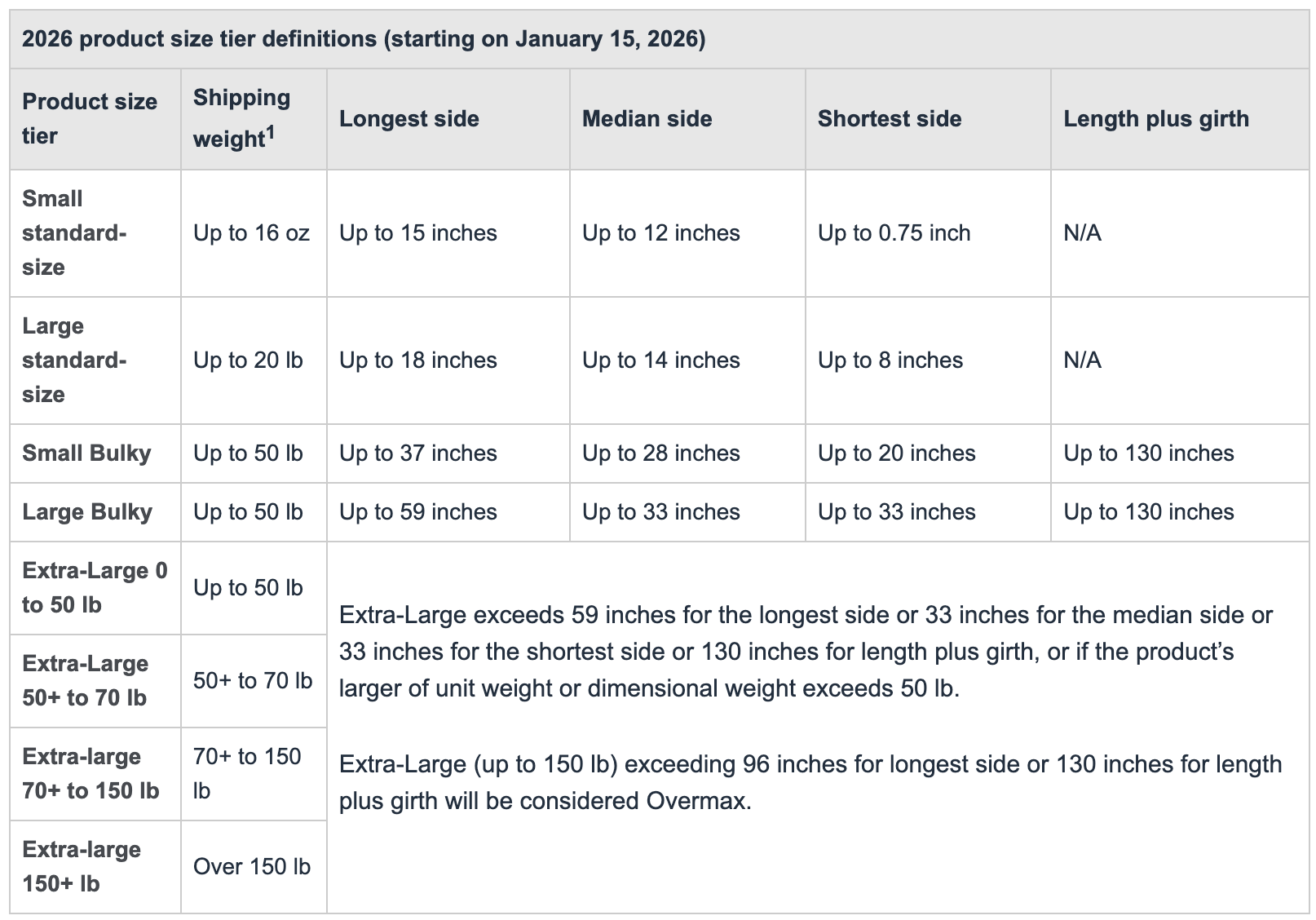
More granular tiers (e.g., Small/Large Bulky)

1. FBA Fulfillment Fees – New Tiered Table (Price-based)

What’s changing:
Amazon updated how fulfillment fees are calculated based on product price brackets, not just size/weight. This new structure applies starting January 15, 2026 for the US. 

Key highlights (from official Amazon announcement):
✔ For products in the $10–$50 price range, the fulfillment fee will increase by about $0.08 per unit on average.
✔ Smaller and larger items will have slightly different adjustments, often higher for smaller products under $10 or high-price items over $50. 

Why it matters:

  • Sellers of low- to mid-priced items will see a modest fee increase per sale.
  • Because Fulfillment-by-Amazon (FBA) fees are charged per unit, the increased cost compounds quickly at scale.

💡 This is not a new fee type, it’s a restructuring and general increase to reflect actual handling and shipping cost differences across price ranges.

Learn more about the news.


2. Overmax Handling Fee

What it is:
The Overmax Handling Fee applies to extra-large or irregularly shaped products that exceed certain dimensional limits. 

When it applies:

  • If an extra-large product (up to ~150 lb) has a longest side > 96 inches or its length + girth > 130 inches, Amazon flags it as “Overmax.”

Impact for sellers:

  • If you sell tall, long, oddly shaped, or irregular products (tubing, poles, equipment), these new surcharges hit you where previously you just paid the standard oversized fulfillment fee.
  • The new “Overmax Handling Fee” means an extra per-unit surcharge for these awkward shipments, on top of standard FBA fees.

Read more here.


3. Low-Inventory-Level Fee - Now FNSKU Based

What’s changing:
Amazon will calculate Low-Inventory-Level Fees at the FNSKU level instead of the parent ASIN level. 

What that means:

  • Previously: Amazon looked at inventory for a whole parent product (all variations combined) to decide if you’re “low.”
  • Now: Each individual FNSKU (variation or unit level) is assessed separately. 

Why this matters:

  • Some child SKUs that were balanced by other child SKUs in stock may now incur fees on their own.
  • Sellers need granular inventory planning – avoid situations where one variation falls below the supply threshold while others are fine.

Reminder – what the fee is:
Amazon charges this when your stock is insufficient relative to demand (based on historical data), encouraging sellers to keep enough inventory on hand.

Amazon resource – read more.


4. Product Size Tiers - Updated Table

What this refers to:
Amazon uses product size tiers to calculate your FBA fulfillment fees (e.g., small standard, large standard, bulky, etc.). 

What’s changed:

  • Amazon periodically updates how they define those tiers using actual item dimensions, weight, and dimensional weight
  • This helps Amazon ensure fees reflect the true cost to pick, pack and ship items of various shapes and sizes.

Seller takeaway:
✔ Knowing which size tier your products fall into is critical – one tier shift can meaningfully change your fulfillment fee.

Read more here.

Overall Takeaways for Sellers

  1. Fulfillment fees overall are rising modestly: average around +$0.08 per unit but with variation by price tier. 
  2. Special handling for extra-large/overmax items means you must consider dimensional strategy to avoid surprises. 
  3. Inventory health matters more than ever – the low-inventory fee charging per FNSKU means tighter supply planning.
  4. Product size classification updates affect fees: always double-check which tier your SKU lands in.


Quick Tips for Managing These Changes

  1. Review all your SKUs by price tier: update profit models to include the new fee structure.
  2. Watch inventory levels at FNSKU granularity: consider safety stock strategies so you don’t get hit with low inventory charges.
  3. Check bulky/overmax thresholds: adjust packaging or fulfillment methods where possible to lower handling fees.
  4. Use FBA calculators and reports to forecast how these changes will affect margins.
Sellerise Team, Contributor

Ready to scale your Amazon business?

Free 7 days trial. No Credit Card Required.